
— Educational Engagements Across Bharat
The Institutional Manifesto : The Missing Anchor.
Cultivating Character Before Capital: Aligning Intellect with Restraint.
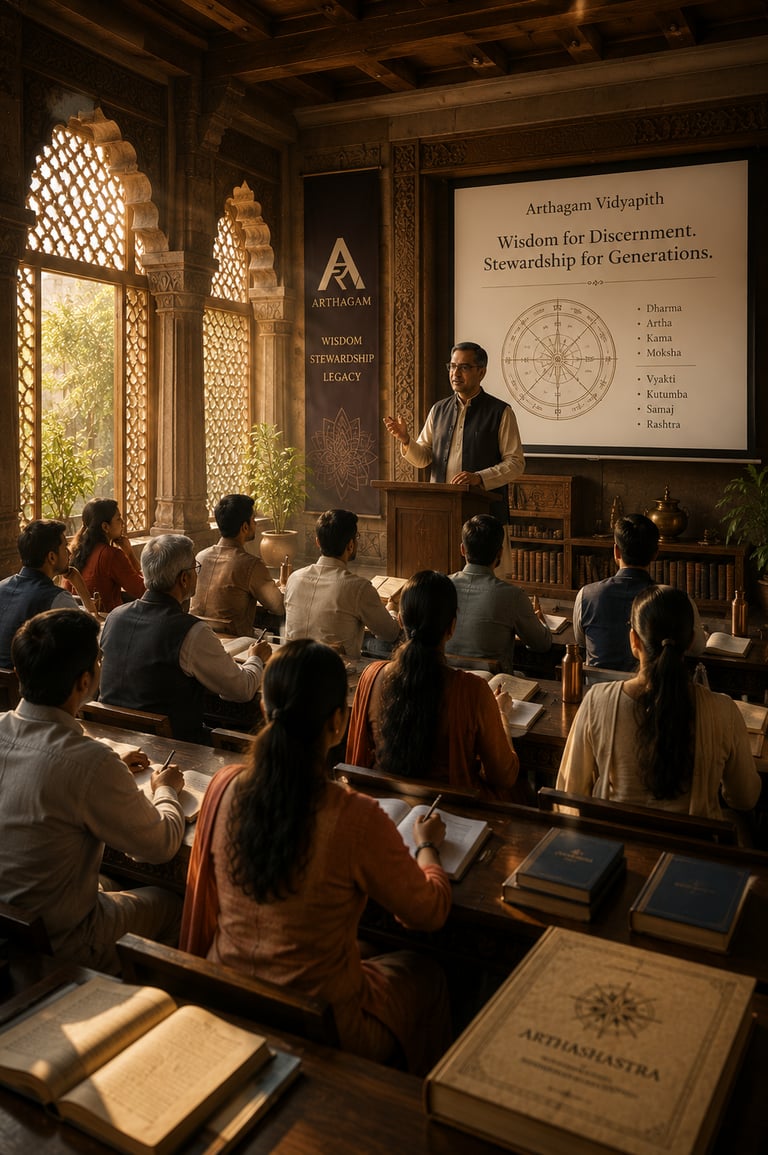
Modern education develops competence. Arthagam Vidyapith develops judgment.
Drawing upon time-tested Bharatiya principles of character, stewardship, Anushasana (self-discipline), and Viveka (discernment), our educational engagements help students, educators, and families cultivate the internal foundations necessary for responsible prosperity and long-term flourishing.
Because enduring success begins not with capital, but with character.


/ The Foundation of Right Action
The Twin Foundations of Responsible Action
Our educational framework does not teach product selection or transactional decision-making. It prepares students to approach resources through classical behavioral discipline.
• चित्त निग्रह (Chitta Nigraha)
Mental Restraint
Mastering internal impulses, desires, and short-term emotional reactions (*Raga*).
• पुरुषार्थ (Purushartha)
Balanced Living
Aligning the pursuit of material growth (*Artha*) within the boundary of universal ethical duties (*Dharma*).



— Age-Appropriate Learning Modules
Lessons That Shape How You Think
• Module I: Foundational Wisdom
• Module II: Strategic Temperament
• Module III: Institutional Excellence
The Pancha Kosha of True Abundance
Navigating Your Internal Kurukshetra
The Arthashastra of Stewardship
Learning Focus:
Needs versus impulses: recognizing the difference between necessity and desire.
Dama (restraint): understanding how self-control shapes long-term outcomes.
Stewardship lessons from the Ramayana and Mahabharata.
Core Objective: Understanding why lasting prosperity extends beyond money alone.
Core Objective: Developing emotional balance before major life and financial decisions.
Learning Focus:
Nishkama Karma: acting with commitment without attachment to outcomes.
Social comparison and Irshya: understanding modern sources of distraction.
Chanakya's reserve doctrine: preparation before consumption.
Core Objective: Understanding how institutions endure through stewardship and responsibility.
Learning Focus:
Stability versus speculation: lessons from enduring wealth systems.
Lineage thinking: understanding responsibility across generations.
Sthitaprajna leadership: cultivating stability amid uncertainty.
The Universal Learning Framework.
Each module translates timeless Bharatiya wisdom into practical habits, judgment frameworks, and responsible decision-making.
/ Institutional Engagement Inquiry
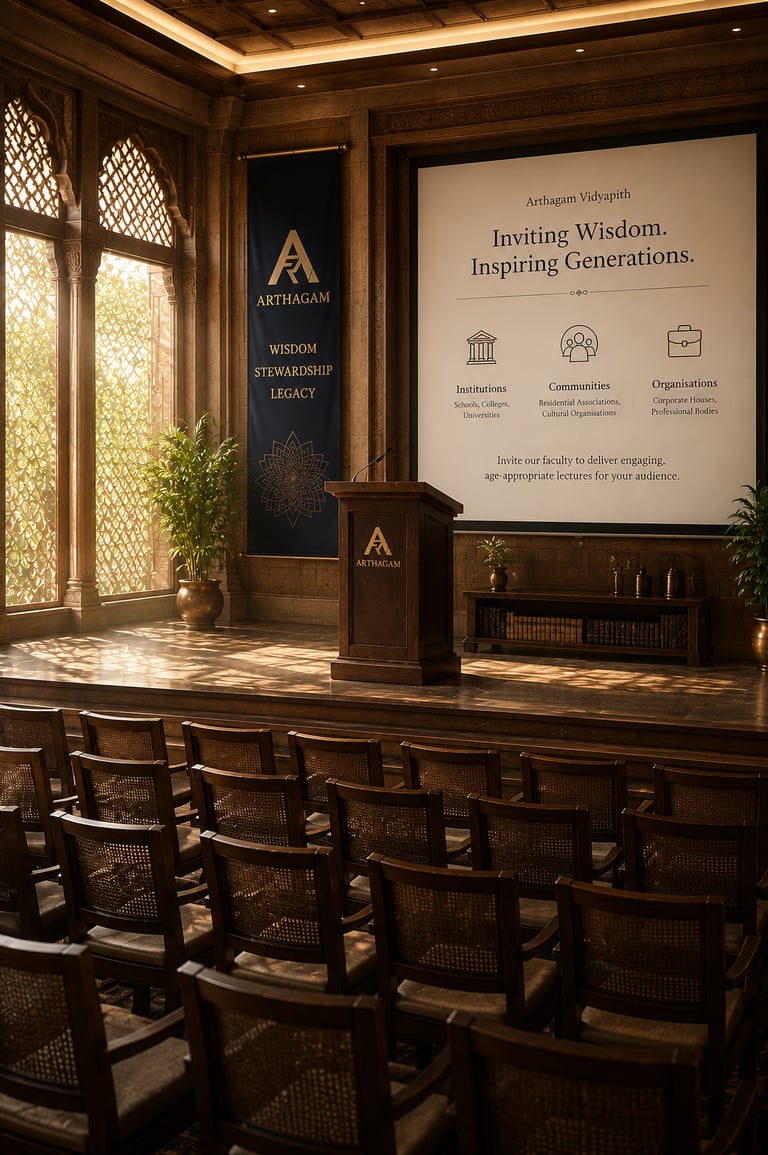
Invite Arthagam Vidyapith to Your Institution.
Arthagam Vidyapith conducts educational assemblies, faculty dialogues, trustee interactions, and student engagements across Bharat. Our sessions focus on timeless principles of wisdom, stewardship, character, and responsible decision-making.
To ensure meaningful engagement and proper coordination, we recommend initiating requests at least 14 days in advance.
Institutional Engagement Process:
Step 1: Submit an institutional inquiry through the contact link below.
Step 2:Arthagam reviews the proposed audience, session objectives, and preferred timeline.
Step 3: Session details are coordinated jointly to ensure relevance, context, and educational value.
▸ Philosophy into Action
Every Lesson Here Anchors a Behavioral Transformation
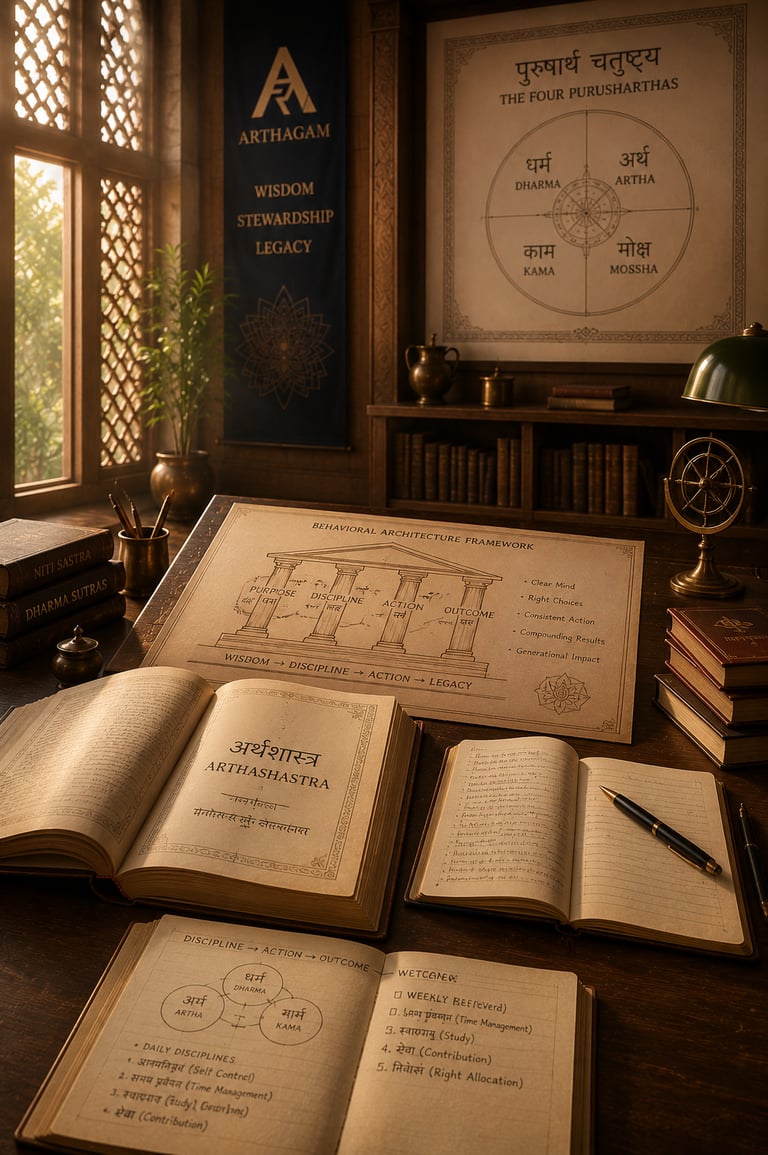
Most educational content treats culture as a decorative backdrop. Arthagam treats it as foundational architecture. Each framework—whether the Arthashastra’s reserve doctrine or the Gita’s action without attachment—maps directly onto a core lifelong discipline, a systematic habit, or a durable decision-making framework.
This learning is not enrichment for its own sake. It is the essential conditioning of the mind (Chitta Nigraha) before execution begins. It prepares you to master short-term impulses, ensuring your lifelong choices always honor generational stability over transient noise.
Align your institution with a framework that has outlasted every age.
The Arthashastra was written for those who build order before ambitions.
Study Chanakya — and see how little human nature has changed.